Why Healthcare AI Projects Fail and How Structured Clinical Data Changes the Equation by Dr. Tim O'Connell · 7 minutes
Executive Summary
More than 80 percent of healthcare data is unstructured and difficult to use
Valuable clinical information remains trapped in notes, reports, and documents
General-purpose LLMs alone are not sufficient for clinical data extraction at scale
Successful healthcare AI initiatives focus on measurable ROI and workflow integration
Structured clinical data improves accuracy, efficiency, and cost control
Why Does Healthcare Still Struggle with Data Accessibility?
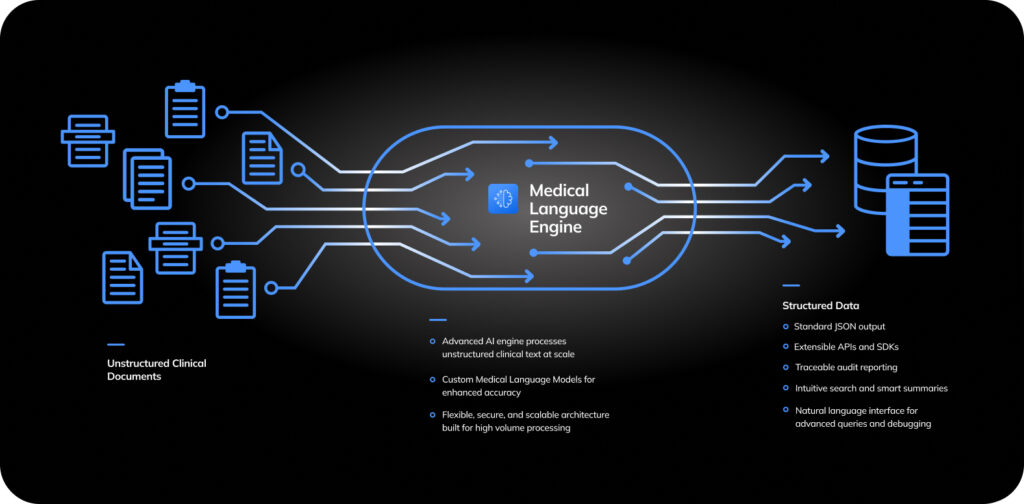
Healthcare organizations have invested billions in electronic health records. The good news is that clinical data is now digital. The challenge is that much of the most valuable information remains trapped inside clinical notes, pathology reports, radiology reports, referral documents, and scanned records.
Industry estimates suggest that more than 80 percent of healthcare data is unstructured.
That means organizations often have access to information but cannot easily analyze, search, or operationalize it. For example, a diagnosis code may indicate that a patient has prostate cancer. However, critical prognostic information such as Gleason scores may only exist within narrative clinical documentation. Without access to those details, healthcare organizations lose valuable clinical context.
What Makes Unstructured Clinical Data So Valuable?
Unstructured data contains information that often never appears in structured fields. This includes:
Disease severity
Clinical timelines
Symptoms
Treatment history
Physician observations
Care recommendations
Healthcare organizations use this information for:
Risk adjustment
Clinical research
Real-world evidence programs
Population health initiatives
Quality reporting
Care management
The challenge is finding it efficiently. Historically, organizations relied on manual chart review to locate this information. That approach does not scale.
Why Traditional Search Tools Fall Short
Many healthcare organizations still rely on keyword searches. While keyword searches can locate words, but cannot reliably understand meaning. Consider these examples:
“No history of diabetes”
“Rule out lymphoma”
“Prior stroke in 2018”
A keyword search may identify the condition but miss the clinical context. Instead, healthcare data requires systems that understand:
Negation
Temporality
Clinical relationships
Medical terminology
Synonyms and abbreviations
Without that context, healthcare organizations risk making decisions using incomplete information.
Why General-Purpose LLMs Are Not Enough
Large language models have transformed how organizations think about AI. They are powerful tools, but they are not complete healthcare data solutions.
LLMs act like an incredibly flexible software development kit. They can attempt almost any task – but the problem is consistency. Healthcare organizations require:
High precision
High recall
Traceability
Auditability
General-purpose LLMs can struggle with:
Hallucinations
Long clinical documents
Missing information buried within records
Consistent extraction across millions of documents
Healthcare organizations need systems designed specifically for clinical data.
Comparison: General-Purpose LLMs vs Clinical AI
Capability
General-Purpose LLM
Clinical AI Platforms
Clinical terminology
Variable
High precision
Long-document performance
Can miss information
Optimized for clinical records
Traceability
Limited
Source-linked outputs
Hallucination risk
Higher
Structured extraction workflows
Cost efficiency
Can become expensive at scale
Designed for enterprise processing
Workflow integration
General purpose
Healthcare-specific
Clinical data extraction
Inconsistent
Purpose-built
How Structured Data Changes the Equation
Structured clinical data creates long-term value. Instead of repeatedly processing billions of documents with an LLM every time a question arises, organizations can create a structured data foundation once and use it repeatedly. This approach allows healthcare organizations to:
Reduce AI costs
Improve performance
Increase scalability
Accelerate analytics
Support research initiatives
Improve operational efficiency
Structured data becomes an enterprise asset.
Why Do Healthcare AI Pilots Fail?
A widely discussed MIT study reported that 95 percent of enterprise generative AI pilots failed to deliver measurable business value. The problem is rarely the technology itself.
Many organizations launch pilots without connecting them to measurable outcomes. Successful healthcare AI programs focus on:
Operational efficiency
Revenue improvement
Cost reduction
Workflow improvements
Measurable business impact
The world is full of neat science fair projects. For business processes to get implemented, you really need to have an ROI. – Dr. Tim O’Connell
Organizations that begin with a clear business objective are far more likely to succeed.
What Does Successful Healthcare AI Implementation Look Like?
Successful organizations:
Start with a clear use case
Focus on measurable outcomes
Prioritize accuracy
Maintain human oversight
Build trust through transparency
Scale gradually
Examples include:
Prior authorization review
Fraud, waste, and abuse review
Clinical research
Risk adjustment
Population health
Quality reporting
The goal is not replacing healthcare professionals. The goal is helping them work more efficiently and accurately.
Why This Matters Now
Healthcare organizations face growing pressure to improve outcomes while controlling costs. At the same time, data volumes continue to grow. Organizations that can unlock value from unstructured clinical data gain a significant advantage.
They can move faster. They can make better decisions. They can support clinicians more effectively.
Most importantly, they can turn information into action.
Key Takeaways
Healthcare’s biggest data challenge is accessibility, not availability
Clinical AI requires more than a chatbot interface
Structured data creates long-term value for healthcare organizations
High precision and high recall remain essential for healthcare AI
Organizations that connect AI initiatives to business outcomes are more likely to succeed
About the Author
Dr. Tim O’Connell is a practicing radiologist, Founder and CEO of emtelligent, and a member of the Forbes Technology Council. For more than two decades, he has worked at the intersection of healthcare, medical informatics, and artificial intelligence. Before founding emtelligent, he served as Clinical Assistant Professor and Vice Chair of Medical Informatics in the Department of Radiology at the University of British Columbia.